Sunday, October 11, 2015

SINGLE RED HEAT LAMP THERAPY

By Lawrence Wilson, MD

© March 2014, The Center For Development

One of the major procedures that is part of most nutritional balancing programs is the use of a sauna made of three or perhaps four reddish 'heat lamps'. These are large, 250-watt, reddish incandescent bulbs. (Do not use other types of bulbs.) The 'heat lamps' are sold at many hardware stores, Cal Ranch on the internet, and even at Walmart. They are called "heat lamps", but they emit red, orange, and yellow light, and some near and middle infrared rays, as well.
In some cases, however, the sauna is not best. These situations include:
1. I do not recommend sauna therapy for pregnant women, or for babies, or for children under 5 years of age.
2. If one cannot afford a sauna (about $600.00).
3. For shining the light on areas of the body that are hard to reach with the fixed lamps in a lamp sauna.
4. Perhaps, if one is very debilitated.
In these situations, the use of a single reddish heat lamp can be wonderful, and even lifesaving. This article discusses this very simple, yet often very helpful form of healing therapy.
CONDITIONS THAT MAY BENEFIT FROM SINGLE LAMP THERAPY
An isolated reddish infrared heat lamp directed at an area of the body provides excellent and often surprising benefits. Single lamp therapy, in our experience, is simple, inexpensive and safe when properly handled.
Conditions that may benefit, often after just a few treatments, include joint pain, muscle strains, skin rashes, acne, boils and some conditions of the eyes, nose, ears and sinuses. Neck, shoulder, elbow, knee and back pain may also respond. Bladder and vaginal conditions may also respond nicely, especially when lamp therapy is combined with a complete nutritional balancing program.
One patient had a sinus infection that did not respond to antibio-tics or to natural healing methods. She was weak and feverish every even-ing and had constant headaches. By shining an infrared lamp on the sinuses for 10 minutes at a time, six times a day, relief occurred in two days with complete elimination of all symptoms in five days. The patient continued to use the lamp for another two weeks because she said the red light felt wonderful.
Relief in one or two days has also occurred in cases of low back pain, knee pain, nerve root irritation and other local conditions. One can safely shine the lamp on any area of the body in need of healing. However, never shine it on the head area for more than 10 minutes at a time, and a little less for children.
It can also be used on pets and large animals such as horses. Do not place a pet in a sauna, as animals can easily overheat.
HOW IT WORKS
Infrared energy heats the body from the inside, up to several inches deep. The heat and other frequencies the lamps offer improve the circulation, hydration and oxygenation, and often disable or weaken harmful microorganisms, including those that cause Lyme disease and many other conditions. Near infrared also has other healing effects, according to some research.
Apparently, the frequencies emitted by this particular lamp are ex-tremely beneficial.
WHAT BULB OR GLOBE TO BUY
Purchase a 250-watt, reddish 'heat lamp'. They cost between about $10-15.00 USD. Do not use a clear bulb, a halogen bulb or any other type.
Companies that make these bulbs include Sylvania, Philips, Havel-Sli, Westinghouse, General Electric, FEIT and perhaps others. They are all very similar, and any of them are fine.
The bulb need not be pure red - the color varies from a yellowish to a deeper red color. These bulbs are often sold for use in chicken coops as brooder lamps. They are also used in some restaurants to keep food warm, and they are found in some people's bathrooms to heat up the bathroom.
Also, purchase a clamp-on lamp socket rated for at least a 250-watt light bulb. It costs about $10.-20. USD and they are sold at many hardware stores. It should have a guard or reflector and ideally the guard should prevent the possibility of touching the bulb itself, which is extremely hot.
In America, you may buy a reddish heat lamp and a clamp-on socket at most hardware stores such as True Value Hardware, Ace Hard-ware, Home Depot, Lowe's and some Walmart stores.
In Europe: Here is a website to purchase the bulbs in Europe (220 volt version):
http://www.amazon.co.uk/Eveready-Finish-Glass-Edison-Screw/dp/B005XKIFY0/ref=sr_1_6?ie=UTF8&qid=1344334552&sr=8-6
In Australia: Here is a website to buy a heat lamp in Australia (also 220 volts):
https://www.lightonline.com.au/infrared-reflector-heat-lamps/philips-infrared-double-reflector-heat-lamp-250w-red

SINGLE LAMP USE
Use the lamp five to sixty minutes per session, two to ten times per day. If you are using it on your head area at all (ears, sinuses, etc.) use it no more than 10 minutes at a time, and a little less for children.
One sits about 12" to 24" from the lamp and moves the lamp around the area during the treatment. Allow the area to become as hot as one can comfortably tolerate. If the lamp is fixed, move the body slightly. Keeping the lamp on one spot for more than a few minutes causes a slight reddening of the skin that will go away and is not harmful. You will not get a tan from this lamp. Do not touch the lamp and do not keep it on one spot if you feel a burning sensation.
A simple way to do therapy is to clamp the lamp socket to a shelf and sit comfortably near the lamp so that it shines on the desired part of the body without causing strain.
CAUTIONS WITH SINGLE LAMP THERAPY
* When using the lamp on your head area, use it for no more than 5-10 minutes at a time.
* Move the lamp back and forth slightly or move the body part it is directed toward.
* Close the eyes when directing the lamp at the eyes, nose or sinuses.
* Do not use the lamp on an injury for the first 24 hours following the injury.
* Avoid touching an infrared lamp when hot. Also avoid placing it on any surface when hot to avoid igniting or burning the surface.
* Avoid banging the lamp around and avoid splashing water on it, as these could cause it to break.
All information in this article is for educational purposes only. It is not for the diagnosis, treatment, prescription or cure of any disease or health condition.
 Source : http://www.nutritionalbalancinglifestyle.com/single-red-heat-lamp.php

Saturday, October 10, 2015

High-Tech Lights to Help Baby Sleep, or Students Stay Alert

Like many expecting parents, Tracy Mizraki Kraft in Portola Valley, Calif., worried about how her newborn would sleep. So she paid attention when her doctor handed her a light bulb that he said would help her son do just that.
The small amber bulb, called Sleepy Baby, seemed to work well, she said, creating a soothing environment for Leo, now 16 months, as he drifted off to sleep.
For Ms. Mizraki Kraft, the bulb’s appeal was self-preservation. But it is part of a technological revolution coming to homes, offices, hotels and schools through lighting designed to undo the ill effects of artificial light — both overhead and on screen — and help regulate sleep, alertness and even people’s moods.
“Lighting is really not about a fixture in the ceiling anymore,” said Mariana Figueiro, who leads light and health research at the Lighting Research Center of Rensselaer Polytechnic Institute. “It’s about delivering individualized light treatments to people.”


Scientists have understood for years that different levels and colors of light can have powerful biological effects on humans. But that concept has been applied only with expensive bulbs — costing as much as $300,000 — for specialty applications like mimicking the 24-hour cycle for astronauts or treating jaundice in newborns.

Photo

The Sleepy Baby bulb at the Lighting Science Group's workshop in Melbourne, Fla. The company is devoted to the growing market for lighting to enhance rest or alertness, with bulbs like Good Night, and Awake and Alert. Credit Oscar Hidalgo for The New York Times

Now, with lighting technology, especially LEDs, becoming more sophisticated and less expensive, companies are developing so-called biological lighting for ordinary consumers.
The Lighting Science Group makes Sleepy Baby and is among the companies that are most devoted to the growing market for lighting to enhance rest or alertness, with bulbs like Good Night, and Awake and Alert.
But other companies, from start-ups to the biggest lighting manufacturers, have products promising similar results. General Electric announced this year that it would release a color-changing LED as part of its Align product line that is compatible with Apple’s HomeKit system and is meant to automate lighting according to the natural sleep cycle.
Two years ago, Philips introduced the Hue, a Wi-Fi-connected bulb compatible with Apple systems that offers “light recipes” conducive to waking up and winding down. Philips Hue is a\so available in Australian Online bulbs company
Digital Lumens, which makes and manages smart lighting systems for commercial and industrial settings, including supermarkets, is supplying lights for a study at Brown University aimed at controlling brightness and spectrum to promote learning among adolescents. And a company called LumiFi has an app to adjust lighting in homes and commercial spaces like hotels, with settings like Rest, Energize, Focus and Sexy.
“With these kinds of bulbs that are coming to the market, you can suddenly now put better lighting controls systems, very affordable, into the hands of everyone,” said Beatrice Witzgall, an architect and lighting designer who founded LumiFi. “It’s a big revolution.”
Companies are also focusing on a host of health applications for lighting, said Milos Todorovic, who leads bioelectronics research at Lux Research. Among these are changing a person’s mood and affecting actual physical processes inside the body, he said, including using light to enhance collagen regeneration to help heal wounds.
It’s all part of a goal — to undo, in effect, the damage that regular lighting has done to the body’s natural rhythms.

Photo

Fredric Maxik of the Lighting Science Group, the inventor of the Sleepy Baby bulb. Credit Oscar Hidalgo for The New York Times

The new consumer-oriented bulbs, for example, are designed to regulate the body’s basic need to rest and wake up by stimulating receptors in the eyes that signal to the brain when it is time for bed and when it is time to go about the activities of the day.
When exposed to short-wavelength light, the blue end of the spectrum, those receptors suppress the release of the sleep-inducing hormone melatonin.
Since white artificial light, especially the LEDs used in bulbs and illuminated screens, is typically high in blue, exposure after dusk tends to reduce sleepiness and increase alertness, leading to an epidemic in sleep deficiency, said Dr. Charles A. Czeisler, chief of the Division of Sleep and Circadian Disorders at Brigham and Women’s Hospital in Boston and a professor of sleep medicine at Harvard Medical School.
“Just in the last 50 years we have had a tenfold increase in the amount of artificial light being used per capita, so everything is much brighter between when the sun sets and when we go to bed at night,” he said.
That has had the effect of pushing back the body’s internal clock by three to five hours, he added, meaning that people are going to bed later but are “still trying to get up with the chickens.”
Using bulbs after sunset that emit longer-wavelength light, which looks more yellow, can help arrest that cycle not because they induce sleep, he said, but because they interfere less with the hormones and neurons that encourage the body to fall asleep.
Researchers are still determining how spectrum and intensity of light affect the brain, and are looking at ways not only to promote sleep but also to enhance alertness, productivity and learning.
Dr. Figueiro at Rensselaer Polytechnic said intense red light appears to stimulate energy and activity without suppressing melatonin. A student of hers, she said, concluded in a research project that it might be possible to affect energy levels through changing the intensity of lights rather than their color.

Photo

Winn, 8, and Bo Brian, 4, watching videos on an iPad as bedtime approaches. Credit Damon Winter/The New York Times

At Brown University, researchers are looking at both spectrum and intensity to design a system to help adolescents stay alert in school.
“If we just did blue enhanced light it might be better for the circadian timing system, but it might not be as good for the alertness and the academic needs that they have,” said Mary A. Carskadon, a professor of psychiatry and human behavior who studies sleep in children, adolescents and young adults. “We want to see if we can hit on the best combination that will enhance those features.”
It is only now, she said, with the advances in LEDs, engineering and Wi-Fi that the potential exists to take that kind of system, once developed, out of the lab and distribute it broadly at a reasonable price.
What consumers will find reasonable will depend on their priorities, as the bulbs come at a premium. A starter pack of the Hue, which includes three bulbs and a hub that connects to a Wi-Fi router, costs close to $200, with single bulbs costing about $60. Align AM and PM bulbs cost close to $25 and $20, respectively.

The Lighting Science Group is fine-tuning its biological lighting line and expects to bring down prices. For now, though, the Good Night costs about $60, while the Awake and Alert runs around $70.
But with Sleepy Baby, which costs about $30, the company may have hit upon the ideal customers: parents desperate for, well, a sleepy baby.
“When you’re a new mom, you’re ready and willing to try anything that’s going to help you and your child sleep,” Ms. Mizraki Kraft said. “Mainly for my own preservation, I knew that I really wanted him to sleep through the night really early.”
Other parents who have tried the bulb express a similar sentiment.
“It’s a lifesaver, especially when you’re a working mom,” said Susan L. Sheehan, a pediatric and prenatal dietitian in Rhode Island. She put the bulb, a gift from a neighbor, in the nursery when her daughter, Kate, was about 5 months old, and found she no longer woke up as much during late-night diaper changes. “She might just slightly stir and then just go right back to sleep.”
And Chip Brian, a co-owner of Best & Company, a contracting firm in Queens, said that when he put the bulb in his sons’ room, his 4-year-old, an “active night kid,” suddenly slept through until morning. The change was so extreme that his wife thought the boy might be sick and went to check on him, Mr. Brian said. “I was sort of amazed.”

Source : http://www.nytimes.com/2015/09/12/business/energy-environment/high-tech-lights-to-help-baby-sleep-or-students-stay-alert.html?ref=topics&_r=0

Friday, October 9, 2015

Lighting Your Way to a Five-Star Property

If the grandiose allure of hotel lobbies and generous amenities are any indication, it is clear “there’s no second chance to make a first impression” is standard in the hospitality industry. Yet, hospitality settings are at risk for being left in the dark without the right lighting, as this single element can be used to capture guests’ attention, convey the space’s brand identity and create a distinct end-user experience to ultimately encourage repeat visits.

Specifying the Light “Characters”

To make any story come to life, it is essential to have a colorful cast of characters. Similarly in lighting design, illuminating a space requires careful selection of the right sources to achieve a five-star shine that not only helps tell the hotel’s story, but also meets the property’s design and energy goals.
Because one size does not always fit all, the following solutions should be considered to create a mixed-source lighting design that best serves each space’s unique objectives: • Light Emitting Diodes (LEDs): With standard 80+ CRI options available in the smallest possible packages, this highly efficient, versatile light source can deliver the same fixture-to-fixture color consistency previously only found in incandescent and tungsten-halogen sources, all while affording more than 50 percent in energy savings. When aligned with a compatible dimmer, some LED solutions also offer dimming options down to the one-percent range.
  • Ceramic Metal Halides: With a standard CRI of 80+, this high-efficacy source, which can be utilized within high-ceiling, general and accent applications to accentuate a hotel’s architectural features, is suitable where occupancy control and dimming are not required.
  • Compact Fluorescents: Featuring a good CRI of 80+, this efficient source is designed for general, task and wall wash applications, ensuring brightly lit spaces within applications such as business centers and conference rooms.
  • Low-Voltage Halogens: Having the highest CRI of 100, this source’s faceted reflectors enhance perceived brightness within a space and can provide numerous lighting possibilities when paired with an architectural dimming system.
There is also an energy-efficient, sustainable lighting solution often overlooked: daylight. Proper use of this could save hotel managers between 15 to 75 percent in energy savings depending on occupancy patterns, control strategy and the amount of daylight available.

Layering Your Lighting Story

In the competitive hospitality landscape, it is becoming increasingly important to create a “wow factor.” While designers often heavily depend on decorative lighting such as sconces and chandeliers to help achieve this, the accurate layering of ambient, task and accent lighting play an integral part in that powerful first statement.
Ambient lighting
Ambient or general lighting is the main illumination type within a hotel space – and the primary focus of energy reduction efforts. For designers, this can also be one of the most challenging, as they must carefully plan how much ambient light must be added to seamlessly balance with decorative lighting such as chandeliers and pendants.
To effectively blend decorative and ambient light without losing sight of the hotel’s story, architecturally enhancing cove lighting, which can be dimmed or switched, or an effective uplighting system can elegantly – and discreetly – illuminate a space. Alternatively, downlights can target areas in need of focus to create visual interest and highlight unique architectural features.
Task lighting
Task lighting is the functional level of lighting used to accommodate fine visual tasks that require higher levels of visibility. In the hospitality arena, it is often challenging to incorporate this lighting while still maintaining the same level of drama and style – especially in demanding spaces such as casinos, where reduced glare and high clarity is critical. In such instances, merging ambient lighting with more concealed, linear solutions to ensure adequate task illumination is a necessity.
In other hospitality applications, such as a fine dining restaurant, downlights are effective in delivering task lighting without subtracting from the space’s aesthetics. For a touch of home, simple tabletop lamps, as often found within the guestroom or lobby waiting area, also further promote a welcoming feel. This type of lighting is also considered portable (i.e., utilizes a cord and plug) and therefore does not count in energy code calculations.

Accent lighting
Accent lighting is often considered the “emotional layer” of lighting and as a general rule, should be a minimum of four to five times the general lighting level to provide the appropriate contrast. In hospitality environments, this layer can spotlight architectural details and logos through uplighting, key lighting or backlighting to add pizzazz and further reinforce the hotel’s branding.
Recessed lighting fixtures are effective and popular accent lighting solutions, as they deliver a narrow-beam light to “punch up” select areas while offering optimal versatility to meet the needs and tone of multipurpose hospitality spaces such as hotel ballrooms.
Light Narration
If light sources are the characters of a Australian lighting bulb design story, control solutions are the narrators.
In a hospitality setting, pairing lighting fixtures with one of the following control solutions not only affords hotels up to 75 to 80 percent average savings during peak power usage, but the flexibility to support a range of functions:
  • Daylight harvesting systems, which are tuned to control electric lights by minimizing power consumption when daylight integration is maximized
  • Networked lighting, a programmable system that can integrate and master control of the hospitality environment, including lighting, motorized window treatments, thermal and mechanical requirements, as well as security and audio-visual interfacing
  • Wireless control systems, which ease installation due to a lesser need to run wiring from lighting control stations to desired fixtures and allow end-users to address individual or grouped fixtures from a wireless hand-held control station

The Final Chapter

As today’s lighting industry evolves, it is essential to understand the lighting options available, their capabilities and how they will impact the surrounding environment. This knowledge, in combination with the proper layering of light and strategic design, will not only allow hotel managers to reach their goals but also to create an experience that encourages guests to revisit, refer and remember their space.

Choosing the Best Entryway Light Fixture for Your Home

LED light bulbs online Australia
Creating the most welcoming entryway starts with your ceiling light fixture. Image courtesy of Hudson Valley. http://www.hudsonvalleylighting.com/
Creating an impression of your home starts the second your guests walk through your front door. We all know after a long day's work, nothing is more inviting than opening your front door, throwing your keys in bowl on a side table and flicking on the lights. To make sure you and your guests are being greeted by the best lighting, your entryway light fixture needs to appropriately fit your space.
Working with What You've Got
There are numerous sizes of entryways and to get sufficient and welcoming lighting, you need to work with what you've got. If you're dealing with a larger entryway area (8, 10 feet or higher), Light Visions recommends using a wider ceiling-mounted light fixture.
The width of your lighting fixture is an important aspect to consider in balancing larger entryways, because the higher the light, the more ground it will cover. Narrow light fixtures in large entryways create more of a spotlight illumination, which can be aggressive and uninviting – think of the lighting in any interrogation scene in a movie.
On the other hand, smaller entryways should not have massive fixtures as it will create too much bright light and will be a problem for taller guests entering your home.
Choose the Right Bulb
For entryway lights, ceiling-mounted fixtures and chandeliers, lighting your entryway should not require more than 400 watts, DoItYourself.com reported. Specifically for entryways, you will likely want to stay closer to 200 watts to light up smaller to medium-sized spaces.
Additionally, if your entryway light fixture has custom LED light bulbs or dim bulbs, great way to create a warm glow in your home is to use layers. Accent lighting to go along with your ceiling fixture is ideal for a luminance that will invite your guests and make you feel at home the second you flip the switch.
Working Without Your Ceiling
Some entryways don't have the luxury of ceiling space for overhead lighting. If this is the case, try to use multiple accent lights that will highlight your entryway. This can be done with a decorative table lamp and a wall accent light. Doing this will take up limited space and make your entryway an ambient area when you walk in your home.
Visit your local ALA showroom or go online to americanlightingassoc.com to learn more entryway lighting options.

Lighting Your Indoor Plants with Style

Your home's lighting design cannot forget the indoor plants.
No matter the season, indoor plants bring an organic feeling to your home. Putting the outdoors inside is a common home design technique, but many people aren't sure how to adjust their home lighting fixtures around the new greenery.
Most plant owners would believe that natural light should be the primary focus, but you can actually use several artificial light resources to help illuminate your plants. For beginners, you want to focus on the right lighting to make your plants seem like they are in full bloom.
Think Accent Lighting
To help create an earthy atmosphere with your lighting and plants, it's smart to showcase your plants with your light design. A popular way to accentuate your plants is through accent lighting.
This style of light is used to highlight artwork, fireplaces and unique architectural features in your home. There's no reason why you couldn't apply this same style of lighting to your plants.
Accent lighting should be used to create focal points in your home, and if you have a large plant in your living room, the attention could be pushed toward your greenery. Additionally, accent lighting is implemented to create moods. Ensure your lighting sets the right mood with your plants so it's not too bright or dark.
Try Different LEDs
LED light bulbs are unique because they allow you to choose different color schemes more easily. Also, some people worry about placing their plants too close to light fixtures and think light bulbs will burn leaves. However, only incandescent light bulbs generate that much heat, which gives you another reason to switch to LED light bulbs in your house.
LEDs are cool to the touch and will not burn or damage your plants. In fact, the various colors of lights can mesh well with your indoor plants. Depending on the type of mood and overall style of your home, LEDs allow you to have one-of-a-kind options with your home lighting design. LEDs will emphasize both the lighter and bolder colors in your plants.
Avoid Pendant Lights With Plants
Another tip is to stay away from pendant light fixtures with your indoor garden. The direct light from an overhead light can be abrasive-looking and give the appearance your plant is under a sun lamp.
Visit your local ALA showroom or go online to americanlightingassoc.com to learn more about home lighting designs.

Reaching a Higher State: Five New Developments in LEDs


A decade ago, when white LEDs began entering the architecture marketplace in force, early adoption came with misgivings. The new light source would drastically cut electricity consumption over many more hours of life — but the color temperature was cold, or brightness seemed insufficient. Like most disruptive technologies, LEDs promised to revolutionize the industry. Just as soon as users could stop thinking twice about them.
Manufacturers have very quickly remedied those limitations since then, and Architizer asked USAI Lighting to walk us through the most interesting advances. The New Windsor, N.Y.-based manufacturer has a knack for lighting innovation, as family patriarch William Littman built the first fluorescent lights that GE introduced to the public at the 1939 World’s Fair.
Littman’s granddaughter Bonnie is president and CEO of USAI Lighting today. Sitting down with Architizer, she shared several projects that demonstrate the performance and aesthetic capacities of a new generation of USAI luminaires. Boasting recent improvements alongside unbeatable energy efficiency and minimal maintenance, our virtual tour proved that LEDs, once disruptive, are becoming dominant.
Seamless Substitution for Traditional Sources
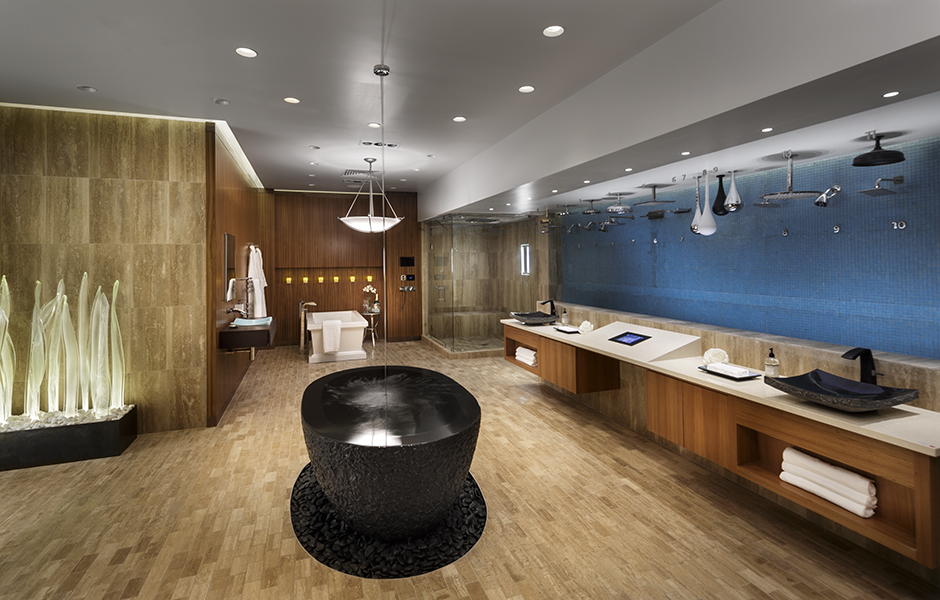
While commercial lighting accounts for more than half of the LED marketplace, LEDs’ penetration of commercial lighting overall still has its best days ahead. The transition from old to new technologies is on display at Pirch, a 24,000-square-foot kitchen and bath showroom in Glendale, Calif., designed by Fitch with lighting design by Santa Monica-based Oculus Light Studio.

Photo Credit: Mark A. Steele Photography, Inc
Residential clientele are welcome to make themselves at home in Pirch; they can even grab an apron and saucepan in one of the demonstration kitchen’s cooking stations. Reflecting this easy interaction, Fitch decided to convey a domestic ambience in the room’s design, and Oculus followed suit with a mix of metal halide adjustable fixtures located in linear ceiling elements, combined with fluorescent wall washers, and LED accents. Utilizing BeveLED 2.0 with Warm Glow Dimming downlights, whose color temperature warms to 2,200 K as they dim, the effect almost exactly mimics the dimming curve of the beloved and familiar incandescent lamps still normally found in most American homes.
Color Customization
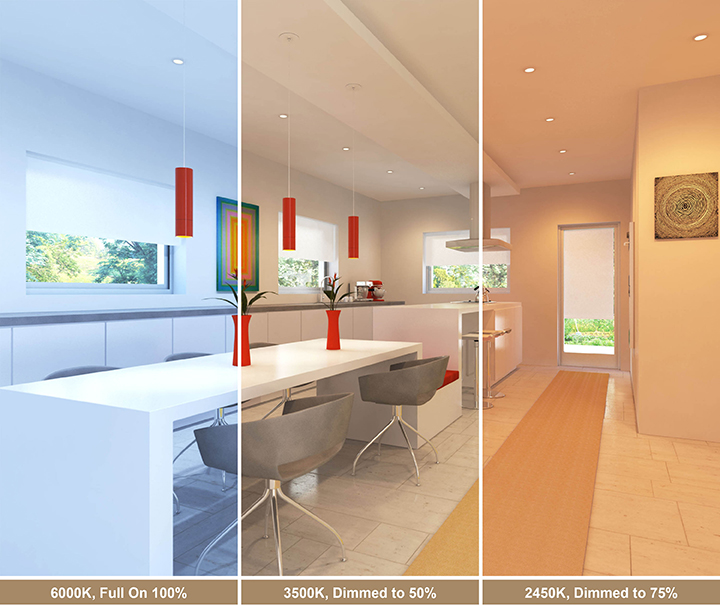
As the dimming spectrum showcased at Pirch suggests, contemporary LED luminaires can give users maximum control over color temperature. Color Select, another proprietary technology from USAI Lighting, is one such tool for color tuning, allowing designers and operators to illuminate a space in white light featuring a color temperature ranging from candlelight’s 2,200 K to the 6,000 K of a cloudless sky.
At Island Hotel in Newport Beach, Calif., local lighting studio Full Circle Design tuned color to orchestrate the mood of the hotel’s in-house restaurant, Oak Grill. The resulting luminaires, called Color Select, produce cooler light for business crowds at noontime, while on leisurely nights and weekends they emit a warm glow. Though Full Circle used Color Select mostly to experiential effect, its color tuning also promises real impact on human performance. Studies of circadian rhythms indicate that the blue spectrum — the color temperature dialed into Oak Grill for lunch hour — prompts energy and focus, while its absence cues the body for relaxation and sleep.

Color Select tuned to three different color and intensity settings in a kitchen
High Performance
According to data collected by the U.S. Energy Information Administration, LEDs are doing more with less: Averaging all LEDs shows that the typical LED produced today gives off 100 lumens per watt, which is significantly more output than just a few years ago. For comparison, a 60-watt incandescent bulb gives off 16 lumens per watt, and that statistic has changed little.
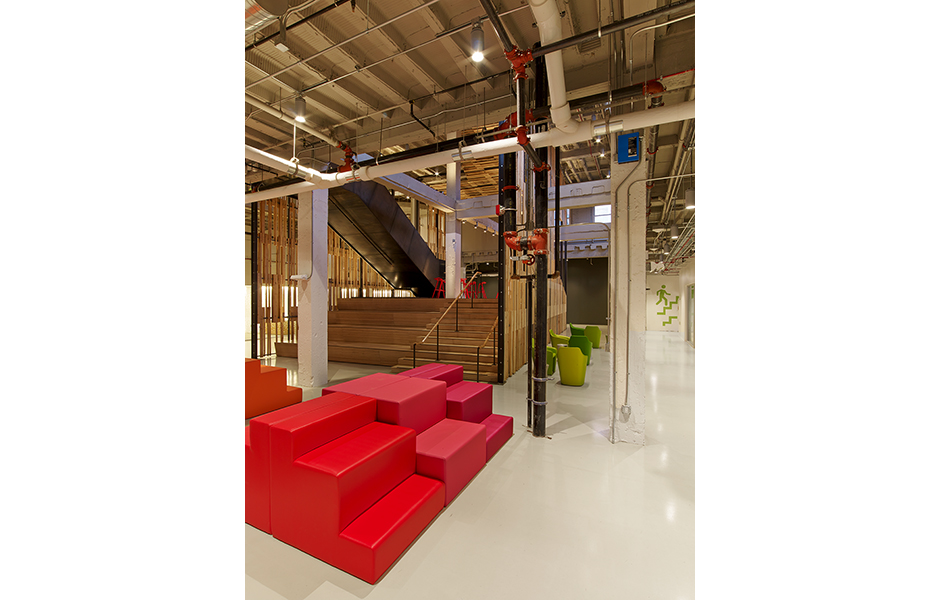
Delivering brighter light without boosting energy consumption certainly benefits the sustainability effort. That should also come as an immediate relief to energy-conscious designers wanting to properly illuminate tall interior spaces requiring powerful light sources. The USAI-made BeveLED 2.0 Cylinder downlights are ideal for such settings, and global studio CD+M Lighting Design sourced them for the Chicago offices of Motorola Mobility. The 605,000-square-foot Gensler-designed space is located within the Chicago Merchandise Mart, where football field-sized floors and high ceilings demand superior output. Illumination from the sleek, 6-inch-diameter cylinders deliver as much as 3,125 lumens and create a comfortable working environment for employees all throughout the space, whether at their desks or elsewhere, while also harmonizing with the tech-industrial appearance of Gensler’s scheme. Other members of the BeveLED 2.0 family offer similar high performance like the Cylinders, such as the BeveLED Max Output product family.

Motorola Mobility Photo credit: Eric Laignel
Multiple Design Solutions
Aesthetics are an even more pressing concern when ceilings are low. That’s one of the constraints that Horton Lees Brogden’s Boston office had to work with when designing the lighting for the Verizon Innovation Center, which is nestled inside a San Francisco office building sporting 8-foot ceilings. The architects at Nelson varied exposed and dropped ceilings to create experiences of compression and expansion in the otherwise confined space. In turn, the Horton Lees Brogden team combined USAI’s NanoLED NXT Cylinder and NanoLED NXT luminaires, respectively. The suspended and recessed fixtures created continuity among LED modules and optics, as well as the related visual vocabulary showcased in the space. The lighting design of this project won it a 2014 IES Illumination Award of Excellence.
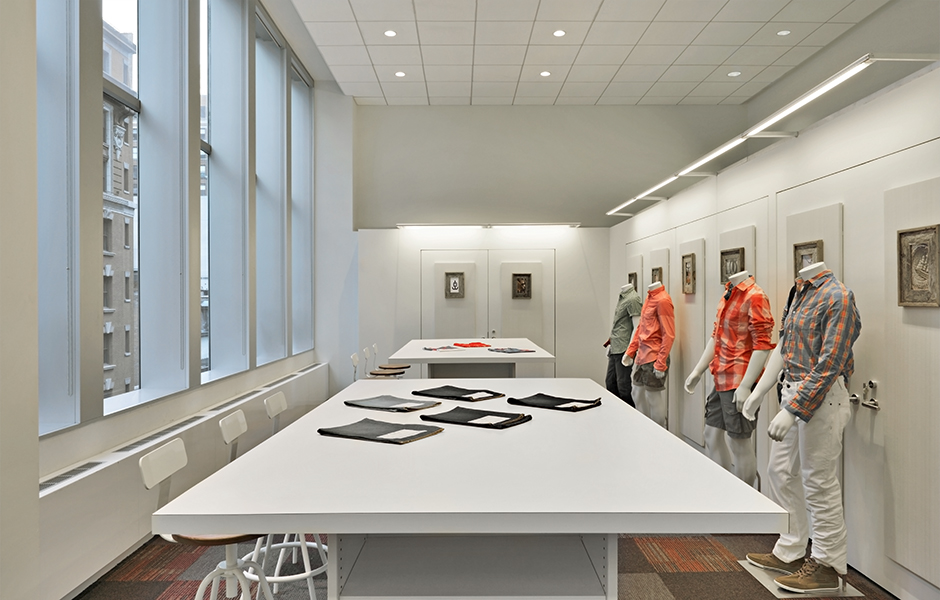
TPG Architecture and One Lux lighting design Studio faced similar conditions when it transformed 42,000 square feet of low-ceilinged space into a new showroom for Perry Ellis International with USAI products. Because the company comprises the Perry Ellis flagship and separate clothing lines with their own identities, TPG created distinct, yet related, showrooms for each. A selection of NanoLED NXT and BeveLED fixtures supported TPG and One Lux’s same-but-different approach; square downlights identify the Perry brand, for instance, and round trimless downlights were specified for Rafaella.

Perry Ellis showrooms: Photo credit: Tom Sibley Photography
Variety also yielded a range of performance outcomes, because a showroom does double duty—as a demonstration retail environment and workplace for both employees and clients. The multiple lighting sources produce necessary ambient illumination, as well as directional lighting for display walls that included options for high lumen output and color rendition to accent specific product lines.
Versatility
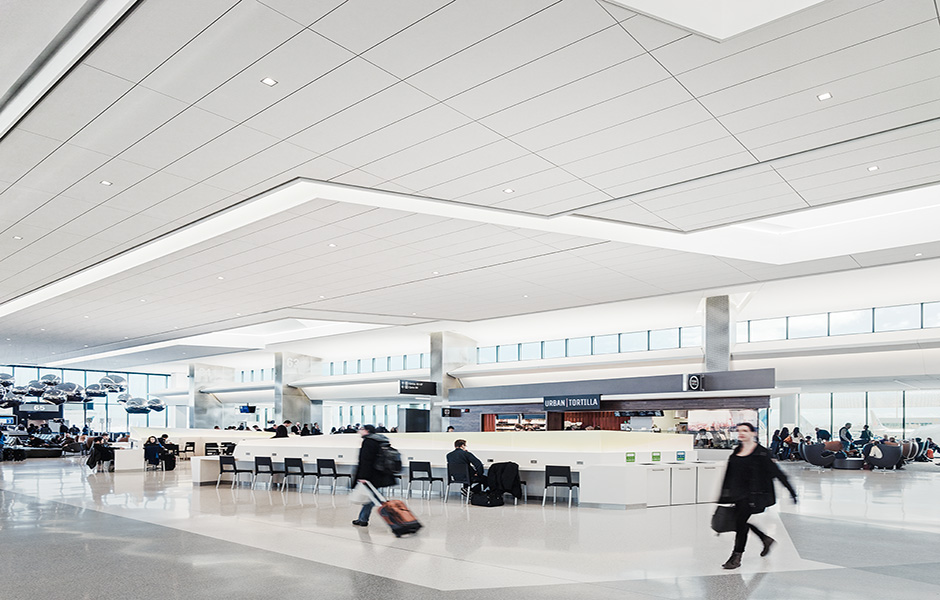
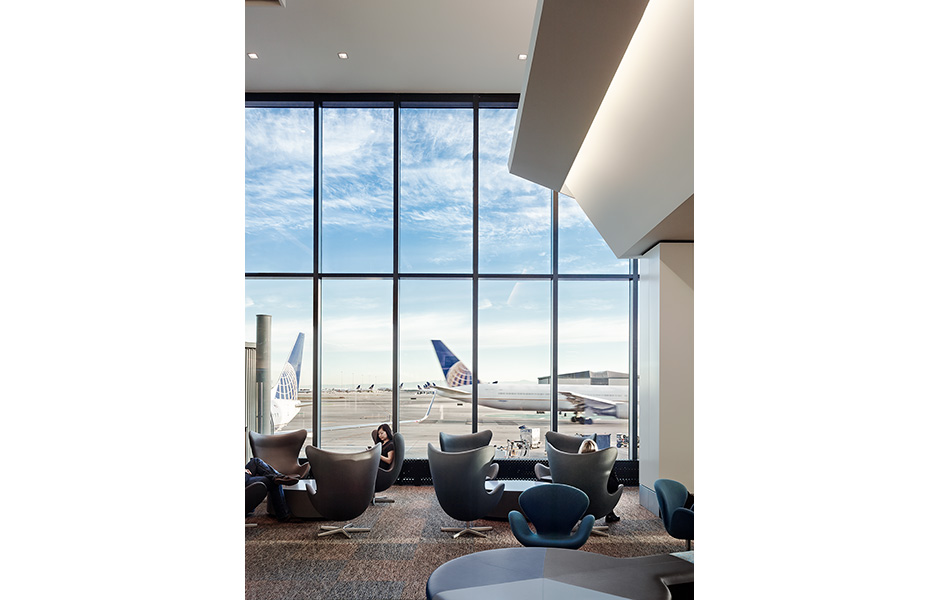
A single fixture can be used in many different ways, as in the example of Birkenstock Lighting Design’s work on the renovation of San Francisco International Airport Terminal 3. Here, lighting goals were as extensive as the $138 million project overall: the design team sought to illuminate the concessions, boarding, and waiting areas, plus the airport’s award-winning collection of art, all while doing better than required by Title 24, the California Energy Commission’s standards for building efficiency.
Birkenstock used BeveLED 2.0 LEDs throughout the terminal, specifying the fixture in different wattages to accomplish wall-wash, downlighting, and other specific tasks. For the sweeping concessions corridor, the studio specified 33-watt BeveLED 2.0 dimmable downlights, and it used 24-watt and 16-watt versions for medium-height and low ceilings elsewhere. In another example, the designers relied on 33-watt BeveLED 2.0 for the airport museum, by using a tighter beam of light to accent the artworks.
That a single luminaire can accomplish multiple tasks sums up the power of today’s LEDs versus those of yesteryear. They boast not just better color temperature or higher intensity, but a whole suite of improvements at once. And by boosting a building’s environmental performance as they always have, this new generation of LED fixtures is not only surpassing traditional expectations for lighting, but setting the bar higher as well.

Above and at top: San Francisco International Airport Terminal 3.
Photo credit: Joe Fletcher Photography
Article published in Architizer, January 22, 2015

Source : http://www.usailighting.com/reaching-a-higher-state-five-new-developments-in-leds-1

Outdoor Lighting: Create an Outdoor Resort in Your Back Yard

This summer many will be spending more vacation time at home instead of traveling to a distant location. According to the American Lighting Association (ALA), with a few updates to your outside lighting, you can enjoy a mini vacation at home. Believe it or not, it’s easier – and less expensive – than you might imagine to transform your existing patio, deck, or pool area into a retreat that you will love (and that will make the neighbors jealous).
 
Rather than buying a costly designer patio set or lounge chairs that will lose their luster by next season, invest in a new lighting scheme that will enhance your existing outdoor furniture and amenities.
 
“The best strategy is to clearly define your objectives,” says Joe Rey-Barreau, education consultant for the ALA and an associate professor at the University of Kentucky’s School of Interior Design. “It’s not necessary to illuminate everything in your yard, so decide which areas are the highest priorities,” he advises. “It is generally better to begin closest to the house, since that is where most activities take place.”
 
Beauty on a Budget
“Creating a beautiful landscape doesn’t have to be expensive,” says Rick Wiedemer of Hinkley Lighting. “A few well-placed, low-voltage path or accent lights can have a huge impact on a well-manicured landscape.” No lawn is too small. “Even modest homes or those with limited yards or gardens can benefit,” he states. “Low-voltage landscape lighting is inexpensive, safe and relatively easy to install. A handy homeowner can put in a low-voltage lighting system over a weekend.”  
 
All that is needed are some basic tools, a transformer (which reduces standard 120-volt household current to the safe 12-volt level), outdoor low-voltage copper cable, and low-voltage lighting fixtures – all of which you can find at your local ALA-member lighting showroom.
  Hubbardton Forge
“It’s an easy project that adds beauty, value and security, and doesn’t take a lot of time,” Wiedemer says.
 
Lew Waltz of Hadco agrees. “The best thing about using low-voltage lighting outdoors is you don’t have to do everything at once,” he explains. “I recommend purchasing a transformer that is larger than you immediately need. Let’s say you want to illuminate the deck area and provide task lighting for cooking at the grill. After selecting the fixtures, you add up the wattage and figure it will use 200 watts of light. However, next year, you might like to add lighting to the patio, highlight some potted plants, and install a water feature in the backyard,” says Waltz. “Instead of purchasing a transformer that is just large enough for the deck, buy one that will operate two to three times that amount of wattage. You only pay for the energy consumed by the fixtures. In other words, a 600-watt transformer that only has 200 watts of fixtures on it, uses 200 watts of energy, not 600,” he says.
 
How do you start? “Select two or three items that are important to you during the daylight hours, such as an ornamental tree, a water feature, a sculpture, etc.,” Waltz explains. “A fixture or two trained on each of these features will make your backyard come to life after dark. You can go back and fill in with some additional lighting later, if the budget is tight this year. By adding three or four fixtures to that larger transformer you purchased for the deck, you still haven’t used all the available power.”
 
Another important tip is to buy the best quality and well-constructed fixtures you can afford. “They will last for decades,” Waltz says, adding, “There are a tremendous number of homeowners who purchase the least expensive fixtures they can find, only to discover that they need to replace them within a year or two. That actually ends up costing more over a 10-year period than if they had purchased better-quality products in the beginning,” he says. 
 
When laying out your project, remember a little light goes a long way outdoors. Consulting with a lighting professional at your local ALA-member lighting showroom can help you avoid making the common mistake of too many fixtures in one area.
 
“I see this happen a lot with path lighting,” Waltz notes. “Folks will place fixtures six to eight feet apart when lighting a sidewalk, and they end up using 10 fixtures for a 50- to 60-foot path. That path can easily be illuminated with three to four fixtures if you select a fixture that is designed by a reputable manufacturer that builds performance into their products,” he advises. “By selecting a fixture from a performance-oriented manufacturer, you will save considerable amount of money on the project by not having to purchase and install extra fixtures to accomplish the desired effect.”
 
These days there are many more decorative landscape lighting fixtures than the basic black path lights. Wiedemer suggests taking inspiration from your home’s interior or exterior architectural elements. “The combination of form plus function is very important,” he says.
  “The idea of enhancing your outdoor environment to reflect your personal style is very popular, especially as we look for more ways to extend the amount of time we spend outside. There are many attractive designs available and you can add color and interest with different glass choices, unique castings, nature-inspired shapes, and architectural elements,” Wiedemer says.
A visit to your local ALA-member lighting showroom will reveal a multitude of styles that will create focal points for your garden or yard while making a decorative statement.
 
Add Light, Not Energy
One of the simplest ways to save on electricity costs is to use a photocell, according to Rey-Barreau. “When it becomes dark or daylight, the photocell automatically turns the lights on and off,” he says. Photocells can be used either for complete outdoor lighting systems or for single fixtures, such as by the back door.
 
“Another common type of control is a timer that turns the lights on and off at specific times,” Rey-Barreau says. “It’s particularly useful to have both a photocell and a timer. With that combination, the timer is set to turn the lights on in the late afternoon, but the photocell will override the timer if there is enough daylight available.”   Wiedemer suggests low-voltage halogen lighting as a less-expensive alternative to a typical incandescent line-voltage system. “Low-voltage halogen operates very efficiently, and the amount of light (lumen output per watt) is much greater than with incandescent bulb equivalents,” he explains.  
 
An even more efficient light source – and what Wiedemer refers to as “a true ‘green’ solution” – is LED. This developing lighting technology provides equivalent light output to that of halogen or incandescent, but at considerable energy savings of up to 75 percent less. Wiedemer estimates the average lifespan of a well-made LED light source to exceed 40,000 hours or more than 12 years of average nightly use. If you install timers with the transformers to turn the system off during late night hours, you will not only cut down even further on energy costs, but will also increase the lifespan of the bulbs.
 
To learn more about lighting your home, inside and out, talk to a lighting professional at an ALA-member showroom or go to www.americanlightingassoc.com.
 
Source : https://www.americanlightingassoc.com/About-ALA/Press-Releases/Featured-Article---Outdoor-Lighting.aspx

LED Lighting Home Energy Savings Guide

With the advent of LEED certification and the general trend towards green technology and home efficiency, lighting technology has become an increasingly critical component of “going green”. While these make nice catch phrases, we hope to dive deeper into the subject and provide a solid knowledge base for those seeking a better understanding of energy efficiency as it pertains to lighting technology.

Home lighting technologie
Some of the most popular lighting technologies for residential and commercial applications include:
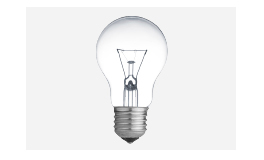
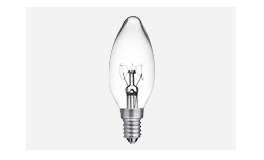
incandescent light bulb online AustraliaIncandescent: This bulb consists of a glass bulb enclosure containing a wire filament. Electric current passes through the filament, which then heats up and radiates the energy as visible light. Incandescent has been the most common type of bulb for over 100 years and has long held the standard for color rendering and consumers' expectations of how a light bulb should operate, but is slowly being phased out by the Energy Independence and Security Act of 2007 due to its inefficiency. Most incandescent bulbs will be out of production by the end of 2015. Incandescent lamps also emit a significant portion of their energy as ultraviolet and infrared radiation, which are invisible to the human eye but potentially damaging to precious and/or light-sensitive objects. Learn more about replacing your incandescent lights and our Warm Glow Dimming products.
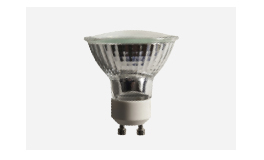
halogen lightHalogen: A more advanced form of incandescent, the halogen bulb uses halogen gas and a tungsten filament to increase light output and efficiency of the incandescent light bulb. They are known for slightly higher efficiency than typical incandescents, and a brighter, whiter light than is provided by the original incandescent bulb. Halogen lamps are usually the first choice for homeowners, as they are better suited for directional aiming of fixtures and provide more focused beam patterns when used in reflector-lamp formats. Halogen lamps are often used on movie sets and in auto headlights, and are typically found in spotlights and floodlights. General Electric was the first to patent and sell this bulb in 1959. The biggest drawback? The exceptionally short lamp life, similar to that of incandescent lamps, makes these expensive to maintain, especially in high or hard-to-reach locations. Learn more about replacing halogen lighting and our Mini Warm Glow Dimming products.
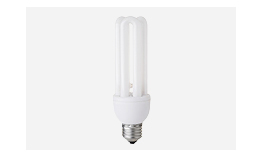
Compact fluorescent: CFLs don’t use a filament to produce light; instead they use a glass tube coated with phosphors that contains a small amount of argon and mercury vapor and electrodes at one end. When electricity is applied, the electrodes generate an invisible ultraviolet light that then excites the fluorescent coating on the inside of the tube to produce visible light. Initially the bulb takes a little longer to turn on, but once on they use about 70% less energy than the equivalent incandescent lamp. The color quality of compact fluorescent lamps is usually subpar as compared with halogen and incandescent, and the dimming performance is not as smooth either, rarely getting down to the minimum light levels that incandescent and halogen can. However, the lamp life is significantly longer - lasting up to 10,000 hourrs and more. Learn more about replacing compact fluorescent lighting and our Color Curve Dimming products.
Metal halide: High intensity discharge technology is an arc lamp technology which was developed in the 1960’s.  Inside a glass envelope filled with argon gas is an arc tube made of either quartz or ceramic and contains mercury and metal halide salts. The mixture of gas, mercury and halide salts within the tube generates an intense bright white light once heated by the electric arc contained inside. Metal halide lamps are very efficient, have excellent lamp life (some over 20,000 hours), and are capable of putting out a tremendous amount of light, so they’re typically used for high ceiling applications where lots of light is needed, stadium lights, roadway lighting, and parking lot and other exterior lighting applications.  The main drawback of metal halide lamps has to do with switching and dimming. Most metal halide lamps cannot turn on while "hot", which means if the power goes out, a restrike time of 15 to 20 minutes is required in order for the lamps to cool off enough to turn back on again. In addition, they are nearly impossible to dim. So although they are great at putting out a lot of light, hopefully that's what you want - because there is only one setting, and that's at 100%. Learn more about replacing metal halide lighting and our Max Output 5.0 products.
Energy saver light bulbs online in AustraliaLED: LEDs, or light-emitting diodes, are a solid state technology that have no filament, glass envelope, gas, or mercury. LEDs produce light by the movement of electrons that results from applying an electric voltage difference across a semiconductor material. Each semiconductor material produces light of a specific wavelength range, so on their own, LEDs are not capable of producing white light. Similar to other technologies, white light can be generated with a phosphor coating, while the excitation energy is typically provided by a blue light LED. While they don't get hot in the traditional sense, LEDs do generate heat, it's just not in the light path: it comes out the opposite end, and proper dissipation of this heat through careful thermal management is critical in determining the lifespan of the light source. A hot LED will fail, but a well-designed LED light source can be rated for a 50,000 hr life and longer (in lab conditions some LEDs have been said to last over 100,000 hrs). This surpasses the life of an incandescent bulb by tens of thousands of hours. While still not the most common household bulb, LED lights have been used in things for years like cell phones, Christmas lights, traffic lights and televisions. They also use 90% less power than incandescent lights, are ecologically friendly, have zero UV emissions or mercury, and are very durable. Browse all of our LED lighting products.
Understanding cost and efficiency
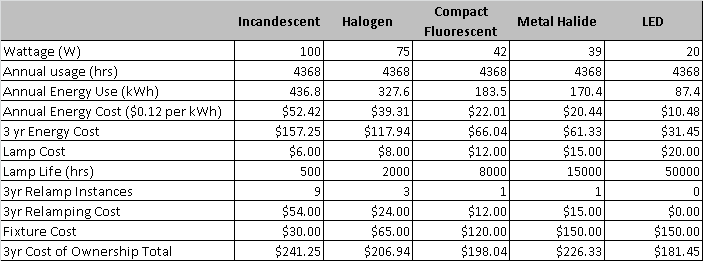
The main factors involved in calculating efficiency and cost are:
  • Fixture cost
  • Lamp life (relamp labor cost and frequency)
  • Lamp cost
  • Wattage per fixture
  • Lumens and lumens/watt (and consequently the # of fixtures needed)
  • Usage (hours/day x days/week x weeks/year)
  • Energy costs
For this sample situation we made the following assumptions in order to estimate cost of ownership over a 3 year period:
  • Lights are on 12 hours per day, seven days per week, 52 weeks per year
  • Average energy cost is $0.12 per kWh
LED lighting conversion cost
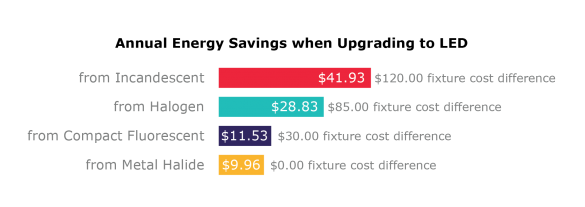
LED lighting ROI
* These numbers are an example for an individual fixture, actual numbers may vary depending on fixtures purchased, energy use patterns, and the size of the project.
Lighting Sustainability Links
The following is a list of internal and external resources on energy saving tips for residential and commercial lighting.
  • DTE Energy: Has tips on lighting, appliances, heating & cooling, and water conservation.
  • Energy.Gov: Indoor and outdoor lighting tips.
  • Duke Energy: 100 ways to save energy at home.
  • JEA: Tips for your office lighting and equipment.
  • CEC: California Energy Commision's Title 24 energy efficiency standards. 
Available Rebates and Tax Credits
The following links will help you find information on obtaining rebates and tax credits for energy efficient lighting products:
  • Energy Star: Add your zip code and then scroll down to see results for light bulbs and light fixtures (why do they need to add the zip code?)
  • Consumers Energy: Their lighting incentive chart has all the information on how to switch over, and what rebates you’ll receive.
  • U.S. Small Business Administration: How to qualify for rebates.
  • Energy Tax Incentives : How to qualify, design advice, and bulb recommendation.
  • Energy Gov: Has information for renewable energy tax credits, as well energy efficiency tax credits for residential properties.